
Subnetting Without Crying (The Pizza Method)
The subnetting method that finally makes sense — no magic, no memorized formulas, just pizza. Funny on purpose, correct on purpose.
Why subnetting feels like a personal attack
Somewhere along the way, someone decided the best way to teach subnetting was binary math, memorized tables, and a facial expression that says 'this is fine' while it is very much not fine.
Here's the actual secret nobody tells you up front: you will never do real binary math for this. Not on the job, not on the exam if you're fast, not ever. You're going to count. That's it. You're going to count in a specific, predictable pattern, and once you see the pattern, subnetting stops being a math problem and becomes a 'read the question, count to the answer' problem.
This guide teaches you that pattern using pizza, because a large pepperoni is easier to visualize at 11pm before an exam than an octet is.
The Pizza Method, in one paragraph
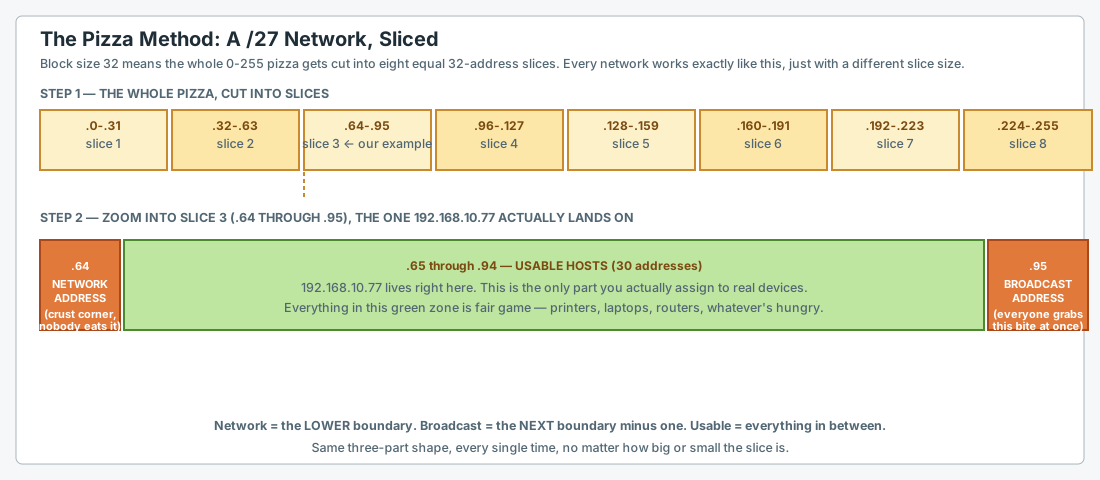
A network is a pizza. A subnet mask is a decision about how many equal slices to cut it into. Every slice is the same size — that size is your 'block size.' The first bite of each slice is the crust corner nobody eats (that's your network address — it identifies the slice, it's not a host). The very last bite of each slice is the one everybody reaches for at the same time and it gets destroyed (that's your broadcast address — every host on the slice receives it, so it's not usable by one host either). Everything in between is what you can actually hand out to hungry hosts.
Step 1: Find the block size (how big is each slice)
Look at the subnet mask's 'interesting octet' — the one that isn't 255 and isn't 0. That's the only octet doing any work.
Block size = 256 minus that octet's value. That's the whole formula. Write it on your hand if you have to.
Example: mask is 255.255.255.224. The interesting octet is 224. Block size = 256 − 224 = 32. Every slice of this pizza is 32 addresses wide.
Step 2: List the slices (count by the block size)
Starting at 0, count up by your block size until you run out of room (256). Those numbers are where each new slice begins.
Block size 32 → slices start at 0, 32, 64, 96, 128, 160, 192, 224. Eight equal slices. Cisco would be proud. Your pizza is now a very geometric pizza.
Step 3: Find your slice (drop the address in and see where it lands)
Take the address you're given and find which two slice-boundaries it falls between. That's your slice.
Example: 192.168.10.77 with a /27 (block size 32). The boundaries are ...64 and ...96, and 77 falls between them. Congratulations, 77 lives on the 64 slice.
Network address = the LOWER boundary (.64 — the crust corner, not a host). Broadcast address = the NEXT boundary minus one (.95 — the bite everyone grabs at once, also not a host). Usable hosts = everything in between (.65 through .94).
The whole method, one more time, fast
1) Block size = 256 − interesting octet.
2) Count up by the block size to list every slice boundary.
3) Find which two boundaries your address falls between — lower is network, next-minus-one is broadcast, the middle is usable hosts.
That's it. That's the entire skill. Everything else people call 'subnetting' is just this, done slightly faster with practice.
The doubling pattern (memorize this once, forever)
Worked example, start to finish
Question: What network is 10.20.30.170/28 on, and what's the usable range?
Interesting octet for /28 is 240. Block size = 256 − 240 = 16.
Count up by 16: 0, 16, 32, 48, 64, 80, 96, 112, 128, 144, 160, 176...
170 falls between 160 and 176. That's your slice.
Network address: 10.20.30.160. Broadcast address: 10.20.30.175 (176 minus one). Usable hosts: 10.20.30.161 through 10.20.30.174.
You just subnetted. No binary. No panic. Order more pizza.
Mistakes that will happen to you (and how to catch them)
Forgetting the network and broadcast addresses aren't usable — the block includes them, but hosts don't get to use them. A /30 has a block size of 4, but only 2 usable hosts, not 4. This is the single most common exam trap.
Using the wrong octet as the 'interesting' one. It's always the one that isn't 255 and isn't 0 — if your mask is 255.255.240.0, the interesting octet is the THIRD one (240), not the fourth.
Rushing the 'which slice' step. Write out at least the two boundaries around your address before answering. Guessing from memory under time pressure is exactly how correct-feeling wrong answers happen.
When you're ready for speed
This guide teaches the method so it actually makes sense. Once it clicks, the ITCertFoundry IPv4 Subnetting Tricks guide covers the same math condensed into exam-speed shortcuts — worth a look once pizza-counting feels easy instead of scary.
Want a printable copy?
This complete guide is also available as a professionally formatted PDF.
Download PDF ↓